Until the Rules Changed
Complete manuscript · representation enquiries welcome
Complete manuscript · representation enquiries welcome
Alex Seton, For Every Drop Shed in Anguish (2020–2023), Australian War Memorial. Photograph: Graham Robinson, February 2026.
The Australian War Memorial, Canberra, February 2026. Sixty-eight days on the road, driving through the geography of his own Australian life, with the marble droplets as the place where the drive turned. He sat. He lingered. He laid a hand on each one. He wept. After about twenty minutes he left, and he was lighter than when he arrived.
Australian War Memorial · February 2026
What happened to me?
He was sixty-six before he could ask it out loud. The answer took fifty years to become tellable, sixty-eight days on the road to find, and one book to tell.
The question the book answersA working-class Belfast-Irish boy is carried across the world by his father’s football, formed by a household where there was no safe move, and handed at sixteen and a half to the Royal Australian Navy, which formed him further and damaged him in ways the country had no category for. He carried that weight, unnamed, for fifty years.
The book is the story of how the rules finally changed: the institutional apology, the compensation, a sculpture of marble tears at the Australian War Memorial, so that he could lay his hand on the stone and tell it the truth, and of what he was while they were changing.
It is the slaying of Sisyphus: the man who finally stops rolling the rock.
There is a place at the Australian War Memorial in Canberra where, since February 2024, two dozen marble droplets sit on grass under plane trees.
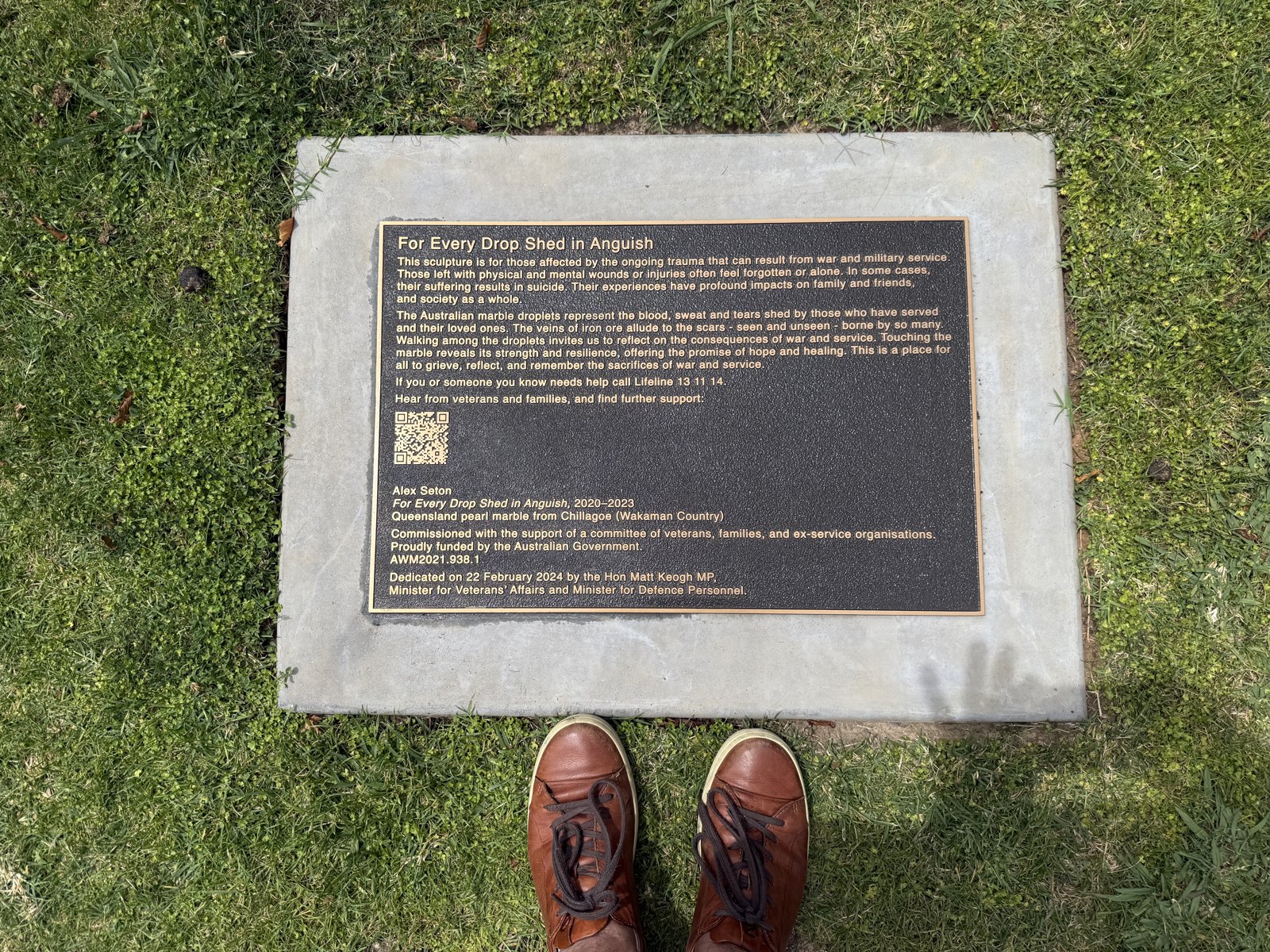
They are tears made permanent. The stone is Queensland pearl marble from Chillagoe, on Wakaman Country. The plaque says the veins of iron in it are the scars, seen and unseen, borne by so many. The sculpture by the artist Alex Seton is titled For Every Drop Shed in Anguish.
In February 2026, I was sixty-six and in the middle of the longest drive of my life. I had left Port Douglas in mid-January with no fixed date to come home. Canberra was a stop during a drive that turned out to be me finding my way through the geography of my own Australian life. You see, driving is when I do my best thinking, and I had a lot to think about.
That morning, by chance, I took my first ever tour of the memorial. I had been to the Memorial many times in my life and had never done one. Me being me, I arrived with a clear plan, I was intent on reading every name on the honour board. Not sure why it was the plan but the plan it was until…
…the nice morning welcome from the staff at reception. I was asked if I’d like to join a small tour group, three or four people plus the guide, Bob. I proudly but subtly, well as subtle as I can be, said no thank you, I’ve been here many times and I have a particular goal today that I wish to achieve. What is that? came the response. Well, I’m going to read every name on the honour board (the names of the fallen). Her response? What, all one hundred and three thousand of them? Mmm, ok then, the tour it is, I responded with my tail firmly captured between my legs. Then off we went, me following Bob closely whilst ensuring I gave him the respect he deserved. In truth, I think I chatted his ears off so much so that after the tour, he asked if I’d like to join him for lunch at Poppy’s Café, a quick bite before he started his next tour at two o’clock. I met him there at one. We talked. I began to share my story.
Around twenty past one, another guide, Barbara, joined us. Bob introduced us and suggested I share my story with her, too.
Bob left to get ready for his two o’clock. I finished telling Barbara.
Stand up.
Sorry?
Stand up, she said. I had a sneaking suspicion I was going to get a hug. She was already crying.
I stood. She hugged me, crying. I hugged her also. I cried. You are very brave, she said.
I told her that although I had always loved visiting the Memorial, on this day it didn’t speak to me. It celebrated death and dying, valour, triumph and disaster. Important and right, but not the place for me that day.
There is a place you need to visit, she said, still holding me. The Alex Seton installation. The stones.
Then I remembered. I had seen the stones on Rachel Griffiths’s When the War is Over, on the ABC. I had simply forgotten the installation existed.
I approached them somewhat tentatively, for reasons unknown. I had this feeling within me that something had or was about to happen. I wasn’t wrong. It was kind of like an out of body experience.
I sat on the bench seat, under a plane tree. I lingered. I stared at the stones. This was the first moment I felt totally alone, yet I had a feeling that all was about to change. The only way was up, but first I had to find the bottom rung of the ladder in order to begin the climb back to the top. After about twenty minutes or more I rose to lay a hand on each one. I wept uncontrollably, the likes I had never experienced before. When I eventually left, I had this overwhelming feeling that I was lighter than when I arrived.
I had been carrying a weight for fifty years. I hadn’t been allowed to call it weight, because what had been done to me did not qualify by the rules of the time. I had not been in a war, nor had I seen combat. By the rules of the country I grew up in, what I was carrying did not qualify for stone.
I had known Sisyphus for a very long time by then, who he was and what he was condemned to, an eternity of pushing a boulder up a steep hill without the prospect of ever reaching the summit, the boulder rolling back to the bottom every time, and I had thought about the similarity for many years. I’d been rolling and retrieving that boulder for what seemed forever.
I had to wait for the rules to change before I could lay my hand on the rock and tell it the truth.
The prologue · from the manuscript, as it stands in September 2026
“The me I was, the me that wasn’t known by me but the me I was, not the me I became through all the acts or deaths of my life.”From the manuscript
Sixty-eight days. Port Douglas south through the whole map of his Australian life: the town where he was raised, the street where he was ten, the base that took him at sixteen and a half driven past and not visited; across to Tasmania and the long way home.


Port Douglas · Townsville · Mooloolaba · Sydney · Nowra · Canberra · Port Augusta · Geelong · Tasmania · and home
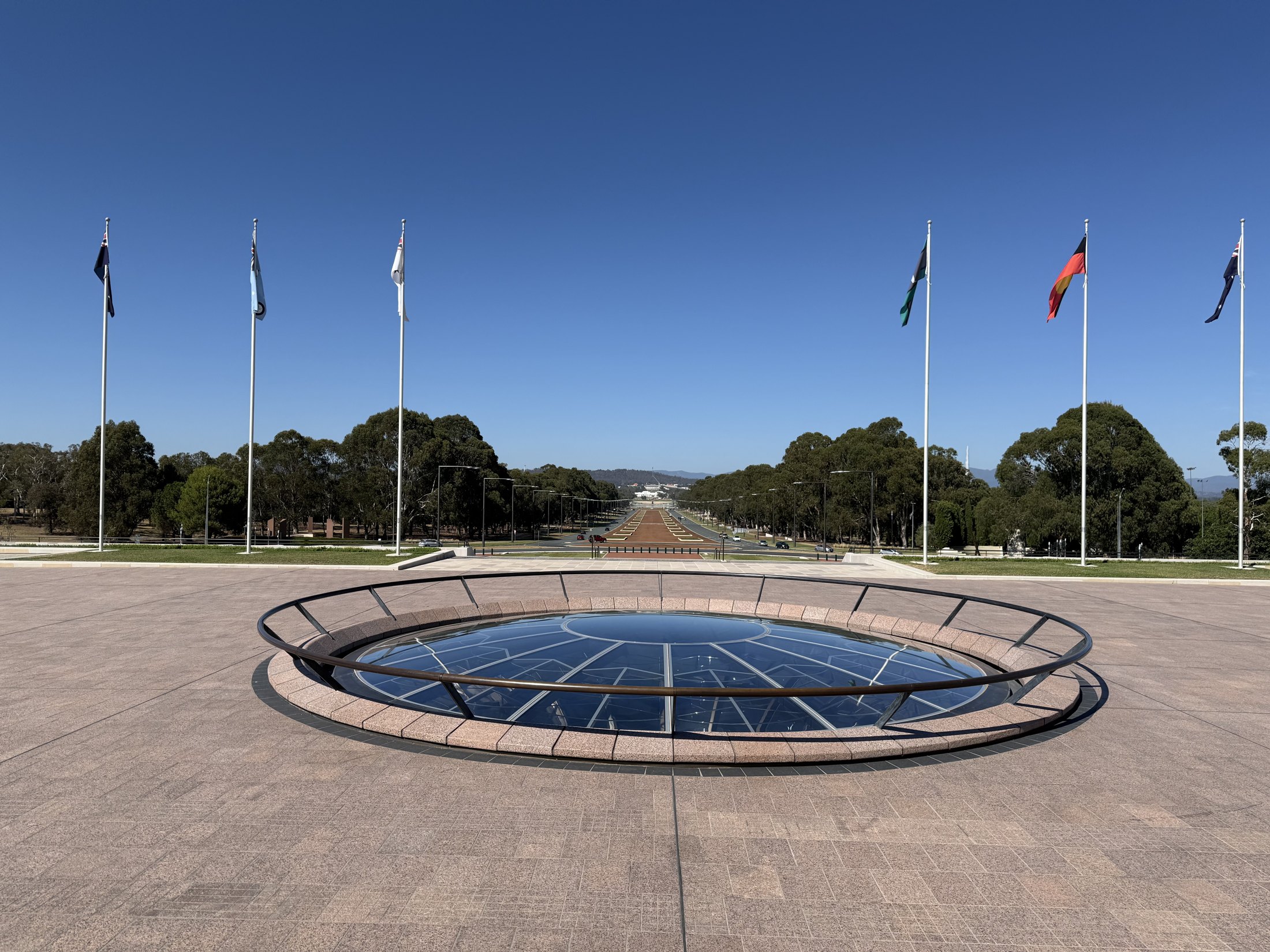
The book’s turning point is set at the Australian War Memorial in Canberra. The Hall of Memory, the Roll of Honour, the Sculpture Garden, and Alex Seton’s For Every Drop Shed in Anguish.



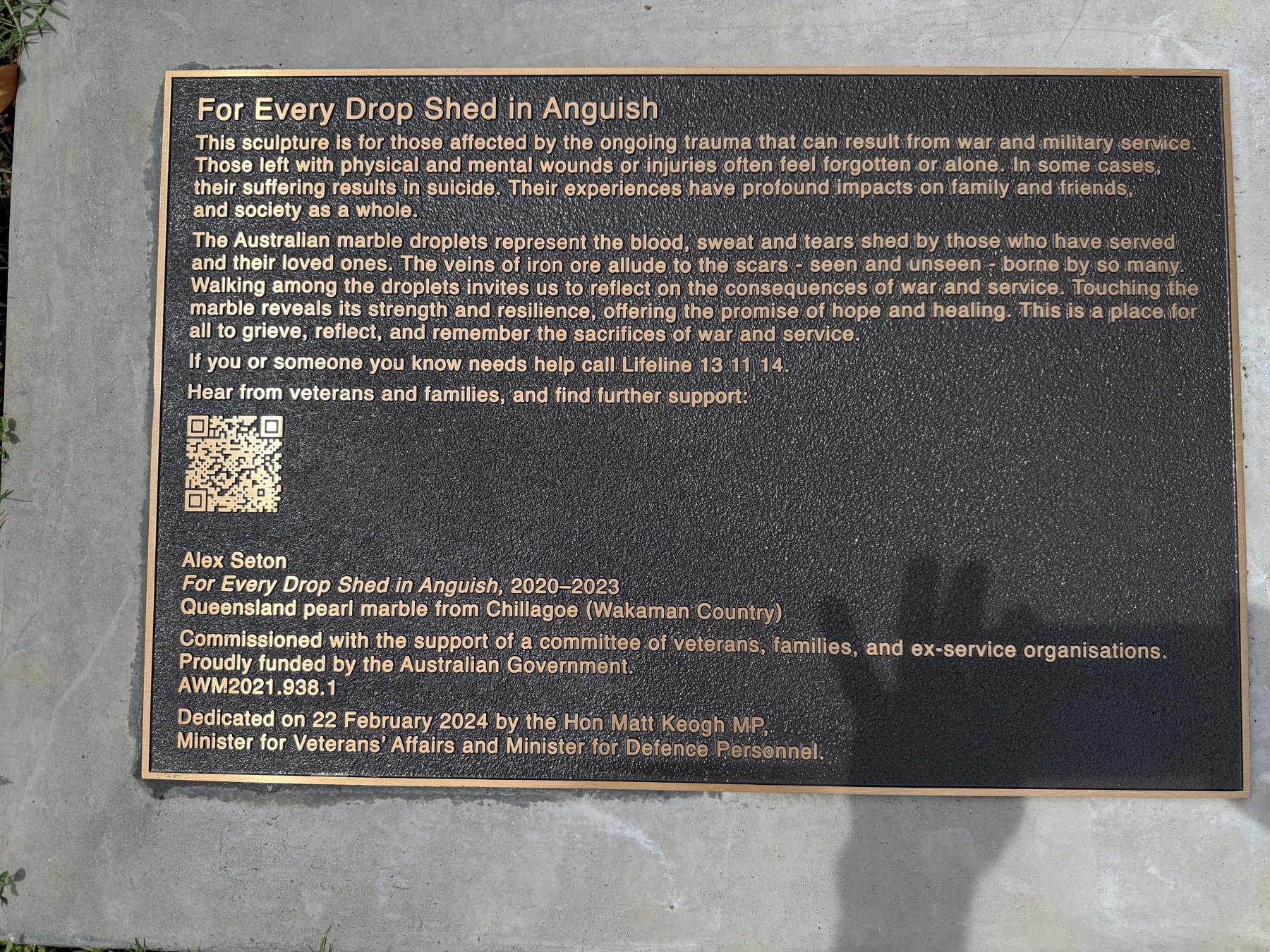
The Australian marble droplets represent the blood, sweat and tears shed by those who have served and their loved ones. The veins of iron ore allude to the scars — seen and unseen — borne by so many. Walking among the droplets invites us to reflect on the consequences of war and service. Touching the marble reveals its strength and resilience, offering the promise of hope and healing. This is a place for all to grieve, reflect, and remember the sacrifices of war and service.
Alex Seton, For Every Drop Shed in Anguish, 2020–2023 · Queensland pearl marble from Chillagoe (Wakaman Country) · Dedicated 22 February 2024 · AWM2021.938.1
Graham Robinson was born in Belfast in 1960. In March 1968 his father, the Irish League and Fulham footballer Harry Robinson, emigrated the family to Australia: Sydney, Port Augusta, New Norfolk, Whyalla, and Port Augusta again.
At sixteen and a half he entered the Royal Australian Navy at HMAS Leeuwin, in October 1976. He served until 1983. He carried what happened to him in those years for the next five decades. He received the formal Navy apology in April 2023. In February 2026, on the longest drive of his life, he laid his hand on the marble droplets at the Australian War Memorial in Canberra.
The manuscript is complete. He is revising it now, page by page.

People look at me, listen to me, watch me — and wonder what I am.The author
I am the outlier. Always have been.
Ladies and gentlemen: I am the product of a life lived. My life. And I survived it.
Five institutional acknowledgments stand behind the book. They are matters of public record, and they came in sequence, each one unlocking the next.
The claim was lodged, represented by Knowmore, and won.
“The appallingly poor behaviour you experienced has caused lasting harm. Senior officers in a position of authority took no action, and effectively abrogated their duty of care towards you. The opportunity to apologise to you has come very late.”
Two dozen Queensland pearl marble droplets, tears made permanent, on grass under plane trees at the AWM in Canberra.
A number of service-connected conditions accepted by the DVA.
Forty years after the discharge stamp read “At Own Request,” the Navy formally acknowledged that at the time of his separation in December 1983, circumstances existed whereby he could have been retired on medical grounds. The institution corrected its own record, and the superannuation owed since 1983 followed. The case was carried by Donaldson Law.

Photograph: Awena Daniel
This book is one man’s story, but it is not only his. If you served, or you carry what was done to you in an institution that was meant to look after you, help exists: free, confidential, and built for exactly this.
1800 011 046
Free, confidential counselling for Australian veterans and their families. Twenty-four hours, every day.
1800 605 762
A free, independent legal service providing advice to survivors of child sexual abuse about justice and redress.
(07) 4580 0900 · donaldsonlaw.com.au
Lawyers for veterans and survivors of institutional abuse. They carried Graham’s Section 37 case, the retrospective medical discharge.
The book is finished, and Graham is now writing about it in public, a piece every fortnight on Substack. It started with the sixty-eight days on the road and the fifty years it took to get there.
Read on SubstackGraham speaks at the Port Douglas Wellness Festival on Saturday 31 October 2026, 1pm, on the Ocean Stage in the Port Douglas Community Hall.
Men’s mental health, told straight by a Navy veteran who carried too much, too long, and finally put it down.
Festival details
A literary memoir for the trade market. Four acts and a present-state epilogue, threaded on the sixty-eight-day drive. Australian-Irish working-class voice. Australian setting, with chapters set in Belfast, London, Sydney, Port Augusta, New Norfolk, Whyalla, Western Australia, Tasmania and Canberra.
The story in three lengths, the verifiable public record with dates and the AWM accession number, the shape of the manuscript, and contact details. Two pages, made for agents, publishers and journalists. Leave your details and it’s yours.
Agents, publishers and journalists are warmly invited to make contact.
graham@untiltheruleschanged.com